Thursday, 28 April 2016

>> Yamaha Corporation is a Japanese multinational corporation and conglomerate based in Japan

Yamaha Corporation is a Japanese multinational corporation and conglomerate based in Japan with a very wide range of products and services, predominantly musical instruments, electronics, motorcycles and power sports equipment.

Yamaha was established in 1887 as a piano and reed organ manufacturer by Torakusu Yamaha as Nippon Gakki Company, Limited  in Hamamatsu, Shizuoka prefecture and was incorporated on October 12, 1897. The company's origins as a musical instrument manufacturer are still reflected today in the group's logo—a trio of interlocking tuning forks.

After World War II, company president Genichi Kawakami repurposed the remains of the company's war-time production machinery and the company's expertise in metallurgical technologies to the manufacture of motorcycles. The YA-1 (AKA Akatombo, the "Red Dragonfly"), of which 125 were built in the first year of production (1954), was named in honour of the founder. It was a 125cc, single cylinder, two-stroke, street bike patterned after the German DKW RT125 (which the British munitions firm, BSA, had also copied in the post-war era and manufactured as the Bantam and Harley-Davidson as the Hummer. In 1955, the success of the YA-1 resulted in the founding of Yamaha Motor Co., Ltd.

Yamaha Machados in Hamamatsu, Shizuoka, Japan

Yamaha has grown to become the world's largest manufacturer of musical instruments (including pianos, "silent" pianos, drums, guitars, brass instruments, woodwinds, violins, violas, celli, and vibraphones), as well as a leading manufacturer of semiconductors, audio/visual, computer related products, sporting goods, home appliances, specialty metals and industrial robots.

In 1989, Yamaha shipped the world's first CD recorder.[chronology citation needed] Yamaha purchased Sequential Circuits in 1988. It bought a majority stake (51%) of competitor Korg in 1987, which was bought out by Korg in 1993.

In 2002, Yamaha closed down its archery product business that was started in 1959. Six archers in five different Olympic Games won gold medals using their products.

It acquired German audio software manufacturers Steinberg in January 2005, from Pinnacle Systems.

In July, 2007, Yamaha bought out the minority shareholding of the Kemble family in Yamaha-Kemble Music (UK) Ltd, Yamaha's UK import and musical instrument and professional audio equipment sales arm, the company being renamed Yamaha Music U.K. Ltd in autumn 2007. Kemble & Co. Ltd, the UK piano sales & manufacturing arm was unaffected.

On December 20, 2007, Yamaha made an agreement with the Austrian Bank BAWAG P.S.K. Group BAWAG to purchase all the shares of Bösendorfer, intended to take place in early 2008. Yamaha intends to continue manufacturing at the Bösendorfer facilities in Austria. The acquisition of Bösendorfer was announced after the NAMM Show in Los Angeles, on January 28, 2008. As of February 1, 2008, Bösendorfer Klavierfabrik GmbH operates as a subsidiary of Yamaha Corp.

Yamaha Corporation is also widely known for their music teaching programme that began in the 1950s.

Yamaha electronic have proven to be successful, popular, and respected products. For example, the Yamaha YPG-625 was given the award "Keyboard of the Year" and "Product of the Year" in 2007 from The Music and Sound Retailer magazine. Other noteworthy Yamaha electronics include the SHS-10 Keytar, a consumer-priced keytar which offered MIDI output features normally found on much more expensive keyboards.
(source)

>> Ducati Motor Holding S.p.A. is an Italian company that designs and manufactures motorcycles

Ducati Motor Holding S.p.A. is an Italian company that designs and manufactures motorcycles. Headquartered in Bologna, Italy, Ducati is owned by German automotive manufacturer Audi through its Italian subsidiary Lamborghini, which is all owned by the Volkswagen Group.

In 1926 Antonio Cavalieri Ducati and his three sons, Adriano, Marcello, and Bruno Cavalieri Ducati; founded Società Scientifica Radio Brevetti Ducati in Bologna to produce vacuum tubes, condensers and other radio components. In 1935 they had become successful enough to enable construction of a new factory in the Borgo Panigale area of the city. Production was maintained during World War II, despite the Ducati factory being a repeated target of Allied bombing.

Ducati Factory

Meanwhile, at the small Turinese firm SIATA (Societa Italiana per Applicazioni Tecniche Auto-Aviatorie), Aldo Farinelli began developing a small pushrod engine for mounting on bicycles. Barely a month after the official liberation of Italy in 1944, SIATA announced its intention to sell this engine, called the "Cucciolo" (Italian for "puppy," in reference to the distinctive exhaust sound) to the public. The first Cucciolos were available alone, to be mounted on standard bicycles, by the buyer; however, businessmen soon bought the little engines in quantity, and offered complete motorized-bicycle units for sale.In 1950, after more than 200,000 Cucciolos had been sold, in collaboration with SIATA, the Ducati firm finally offered its own Cucciolo-based motorcycle. This first Ducati motorcycle was a 48 cc bike weighing 98 lb (44 kg) with a top speed of 40 mph (64 km/h) had a 15 mm carburetor giving just under 200 mpg-US (1.2 L/100 km; 240 mpg-imp). Ducati soon dropped the Cucciolo name in favor of "55M" and "65TL".

Ducati "Cucciolo", 1950

When the market moved toward larger motorcycles, Ducati management decided to respond, making an impression at an early-1952 Milan show, introducing their 65TS cycle and Cruiser (a four-stroke motor scooter). Despite being described as the most interesting new machine at the 1952 show, the Cruiser was not a great success, and only a few thousand were made over a two-year period before the model ceased production.

In 1953, management split the company into two separate entities, Ducati Meccanica SpA and Ducati Elettronica, in acknowledgment of its diverging motorcycle and electronics product lines. Ducati Elettronica became Ducati Energia SpA in the eighties. Dr. Giuseppe Montano took over as head of Ducati Meccanica SpA and the Borgo Panigale factory was modernized with government assistance. By 1954, Ducati Meccanica SpA had increased production to 120 bikes a day.

Ducati Mach 1

In the 1960s, Ducati earned its place in motorcycling history by producing the fastest 250 cc road bike then available, the Mach 1. In the 1970s Ducati began producing large-displacement V-twin motorcycles and in 1973, released a V-twin with the trademarked desmodromic valve design. In 1985, Cagiva bought Ducati and planned to rebadge Ducati motorcycles with the Cagiva name. By the time the purchase was completed, Cagiva kept the "Ducati" name on its motorcycles. Eleven years later, in 1996, Cagiva accepted the offer from Texas Pacific Group and sold a 51% stake in the company for US$325 million; then, in 1998, Texas Pacific Group bought most of the remaining 49% to become the sole owner of Ducati. In 1999, TPG issued an initial public offering of Ducati stock and renamed the company Ducati Motor Holding SpA. TPG sold over 65% of its shares in Ducati, leaving TPG the majority shareholder. In December 2005, Ducati returned to Italian ownership with the sale of Texas Pacific's stake (minus one share) to Investindustrial Holdings, the investment fund of Carlo and Andrea Bonomi.

Ducati 1098 S Tricolore

In April 2012, Volkswagen Group's Audi subsidiary announced its intention to buy Ducati for €860 million (US$1.2 billion). Volkswagen chairman Ferdinand Piëch, a motorcycle enthusiast, had long coveted Ducati, and had regretted that he passed up an opportunity to buy the company from the Italian government in 1984. Analysts doubted a tiny motorcycle maker would have a meaningful effect on a company the size of Volkswagen, commenting that the acquisition has "a trophy feel to it," and, "is driven by VW's passion for nameplates rather than industrial or financial logic". Italian luxury car brand Lamborghini was strengthened under VW ownership. AUDI AG's Automobili Lamborghini S.p.A. subsidiary acquired 100 percent of the shares of Ducati Motor Holding S.p.A. on July 19, 2012 for €747 million (US$909 million).
(source)

>> Porsche AG is a German automobile manufacturer specializing in high-performance sports cars, SUVs and sedans

Dr.-Ing. h.c. F. Porsche AG, usually shortened to Porsche AG is a German automobile manufacturer specializing in high-performance sports cars, SUVs and sedans. Porsche AG is headquartered in Stuttgart, and is owned by Volkswagen AG, which is itself majority-owned by Porsche Automobil Holding SE. Porsche's current lineup includes the 911, Boxster, Cayman, Panamera, Cayenne and the Macan.

Ferdinand Porsche founded the company called "Dr. Ing. h. c. F. Porsche GmbH" in 1931, with main offices at Kronenstraße 24 in the centre of Stuttgart. Initially, the company offered motor vehicle development work and consulting, but did not build any cars under its own name. One of the first assignments the new company received was from the German government to design a car for the people, that is a "Volkswagen". This resulted in the Volkswagen Beetle, one of the most successful car designs of all time. The Porsche 64 was developed in 1939 using many components from the Beetle.

1952 Porsche 356 K/9-1 Prototype

During World War II, Volkswagen production turned to the military version of the Volkswagen Beetle, the Kübelwagen, 52,000 produced, and Schwimmwagen, 15,584 produced. Porsche produced several designs for heavy tanks during the war, losing out to Henschel & Son in both contracts that ultimately led to the Tiger I and the Tiger II. However, not all this work was wasted, as the chassis Porsche designed for the Tiger I was used as the base for the Elefant tank destroyer. Porsche also developed the Maus super-heavy tank in the closing stages of the war, producing two prototypes.

At the end of World War II in 1945, the Volkswagen factory at KdF-Stadt fell to the British. Ferdinand lost his position as Chairman of the Board of Management of Volkswagen, and Ivan Hirst, a British Army Major, was put in charge of the factory (in Wolfsburg, the Volkswagen company magazine dubbed him "The British Major who saved Volkswagen"). On 15 December of that year, Ferdinand was arrested for war crimes, but not tried. During his 20-month imprisonment, Ferdinand Porsche's son, Ferry Porsche, decided to build his own car, because he could not find an existing one that he wanted to buy. He also had to steer the company through some of its most difficult days until his father's release in August 1947

Porsche 911 (991)

The first models of what was to become the 356 were built in a small sawmill in Gmünd, Austria. The prototype car was shown to German auto dealers, and when pre-orders reached a set threshold, production (with Aluminium body) was begun by Porsche Konstruktionen GesmbH founded by Ferry and Louise. Many regard the 356 as the first Porsche simply because it was the first model sold by the fledgling company along with Porsche 360. After the production of 356 was taken over by the father's Dr. Ing. h.c. F. Porsche GmbH in Stuttgart in 1950, Porsche commissioned a Zuffenhausen-based company, Reutter Karosserie, which had previously collaborated with the firm on Volkswagen Beetle prototypes, to produce the 356's steel body. In 1952, Porsche constructed an assembly plant (Werk 2) across the street from Reutter Karosserie; the main road in front of Werk 1, the oldest Porsche building, is now known as Porschestrasse. The 356 was road certified in 1948.

In post-war Germany, parts were generally in short supply, so the 356 automobile used components from the Volkswagen Beetle, including the engine case from its internal combustion engine, transmission, and several parts used in the suspension. The 356, however, had several evolutionary stages, A, B, and C, while in production, and most Volkswagen sourced parts were replaced by Porsche-made parts. Beginning in 1954 the 356s engines started utilizing engine cases designed specifically for the 356. The sleek bodywork was designed by Erwin Komenda who also had designed the body of the Beetle. Porsche's signature designs have, from the beginning, featured air-cooled rear-engine configurations (like the Beetle), rare for other car manufacturers, but producing automobiles that are very well balanced.

Porsche 918 Spyder

In 1964, after a fair amount of success in motor-racing with various models including the 550 Spyder, and with the 356 needing a major re-design, the company launched the Porsche 911: another air-cooled, rear-engined sports car, this time with a six-cylinder "boxer" engine. The team to lay out the body shell design was led by Ferry Porsche's eldest son, Ferdinand Alexander Porsche (F. A.). The design phase for the 911 caused internal problems with Erwin Komenda, who led the body design department until then. F. A. Porsche complained Komenda made unauthorized changes to the design. Company leader Ferry Porsche took his son's drawings to neighboring chassis manufacturer Reuter. Reuter's workshop was later acquired by Porsche (so-called Werk 2). Afterward Reuter became a seat manufacturer, today known as Keiper-Recaro.

The design office gave sequential numbers to every project (See Porsche type numbers), but the designated 901 nomenclature contravened Peugeot's trademarks on all 'x0x' names, so it was adjusted to 911. Racing models adhered to the "correct" numbering sequence: 904, 906, 908. The 911 has become Porsche's most well-known and iconic model – successful on the race-track, in rallies, and in terms of road car sales. Far more than any other model, the Porsche brand is defined by the 911. It remains in production; however, after several generations of revision, current-model 911s share only the basic mechanical configuration of a rear-engined, six-cylinder coupé, and basic styling cues with the original car. A cost-reduced model with the same body, but with 356-derived four-cylinder engine, was sold as the 912.

Porsche Diesel Super

In 1972, the company's legal form was changed from Kommanditgesellschaft (KG), or limited partnership, to Aktiengesellschaft (AG), or public limited company, because Ferry Porsche came to believe the scale of the company outgrew a "family operation", after learning about Soichiro Honda's "no family members in the company" policy at Honda. This led to the establishment of an Executive Board with members from outside the Porsche family, and a Supervisory Board consisting largely of family members. With this change, most family members in the operation of the company including F. A. Porsche and Ferdinand Piëch departed from the company.

F. A. Porsche founded his own design company, Porsche Design, which is renowned for exclusive sunglasses, watches, furniture, and many other luxury articles. Louise's son and Ferry's nephew Ferdinand Piëch, who was responsible for mechanical development of Porsche's production and racing cars (including the very successful 911, 908 and 917 models), formed his own engineering bureau, and developed a five-cylinder-inline diesel engine for Mercedes-Benz. A short time later he moved to Audi (used to be a division, then a subsidiary, of Volkswagen), and pursued his career through the entire company, ultimately becoming the Chairman of Volkswagen Group.

The first Chief Executive Officer (CEO) of Porsche AG was Dr. Ernst Fuhrmann, who had been working in the company's engine development division. Fuhrmann was responsible for the so-called Fuhrmann-engine, used in the 356 Carrera models as well as the 550 Spyder, having four overhead camshafts instead of a central camshaft with pushrods, as in the Volkswagen-derived serial engines. He planned to cease the 911 during the 1970s, and replace it with the V8-front engined grand sportswagon 928. As we know today, the 911 outlived the 928 by far. Fuhrmann was replaced in the early 1980s by Peter W. Schutz, an American manager and self-proclaimed 911 aficionado. He was then replaced in 1988 by the former manager of German computer company Nixdorf Computer AG, Arno Bohn, who made some costly miscalculations that led to his dismissal soon after, along with that of the development director, Dr. Ulrich Bez, who was formerly responsible for BMW's Z1 model, and is today the CEO of Aston Martin.

The Martini Racing blue and green "psychedelic" livery on a 1970 917K. This car raced at Watkins Glen in 1970.

In 1990, Porsche drew up a memorandum of understanding with Toyota to learn and benefit from Japanese lean manufacturing methods. In 2004 it was reported that Toyota was assisting Porsche with hybrid technology.

Following the dismissal of Bohn, Heinz Branitzki, a longtime Porsche employee, was appointed as interim CEO. Branitzki served in that position until Wendelin Wiedeking became CEO in 1993. Wiedeking took over the chairmanship of the board at a time when Porsche appeared vulnerable to a takeover by a larger company. During his long tenure, Wiedeking transformed Porsche into a very efficient and profitable company.

Ferdinand Porsche's nephew, Ferdinand Piëch, was chairman and CEO of the Volkswagen Group from 1993 to 2002, and is chairman of the Volkswagen AG Supervisory Board since. With 12.8 percent of the Porsche SE voting shares, he also remains the second largest individual shareholder of Porsche SE after his cousin, F. A. Porsche, (13.6 percent).

Porsche's 2002 introduction of the Cayenne also marked the unveiling of a new production facility in Leipzig, Saxony, which once accounted for nearly half of Porsche's annual output. In 2004, production of the 456 kilowatts (620 PS; 612 bhp) Carrera GT commenced in Leipzig, and at EUR 450,000 ($440,000 in the United States) it was the most expensive production model Porsche ever built.

In mid-2006, after years of the Boxster (and later the Cayenne) as the best selling Porsche in North America, the 911 regained its position as Porsche's best-seller in the region. The Cayenne and 911 have cycled as the top-selling model since. In Germany, the 911 outsells the Boxster/Cayman and Cayenne.

In May 2011, Porsche Cars North America announced plans to spend $80–$100 million, but will receive about $15 million in economic incentives to move their North American headquarters from Sandy Springs, a suburb of Atlanta, to Aerotropolis, Atlanta, a new mixed-use development on the site of the old Ford Hapeville plant adjacent to Atlanta's airport. Designed by architectural firm HOK, the headquarters will include a new office building and test track. The facility will be known by its new address, One Porsche Drive.
(source)

>> Lamborghini is an Italian brand and manufacturer of luxury sports

Automobili Lamborghini S.p.A. is an Italian brand and manufacturer of luxury sports cars and, formerly, SUVs, which is owned by the Volkswagen Group through its subsidiary brand division Audi. Lamborghini's production facility and headquarters are located in Sant'Agata Bolognese, Italy. In 2011, Lamborghini's 831 employees produced 1,711 vehicles.

Ferruccio Lamborghini, an Italian manufacturing magnate, founded Automobili Ferruccio Lamborghini S.p.A. in 1963 to compete with established marques, including Ferrari. The company gained wide acclaim in 1966 for the Miura sports coupé, which established rear mid-engine, rear wheel drive as the standard layout for high-performance cars of the era. Lamborghini grew rapidly during its first decade, but sales plunged in the wake of the 1973 worldwide financial downturn and the oil crisis.


The firm's ownership changed three times after 1973, including a bankruptcy in 1978. American Chrysler Corporation took control of Lamborghini in 1987 and sold it to Malaysian investment group Mycom Setdco and Indonesian group V'Power Corporation in 1994. In 1998, Mycom Setdco and V'Power sold Lamborghini to the Volkswagen Group where it was placed under the control of the group's Audi division.

New products and model lines were introduced to the brand's portfolio and brought to the market and saw an increased productivity for the brand Lamborghini. In the late 2000s, during the worldwide financial crisis and the subsequent economic crisis, Lamborghini's sales saw a drop of nearly 50 percent.

The Miura began as a clandestine prototype, a car that had racing pedigree in a company that was entirely against motorsport.

Lamborghini produces sports cars and V12 engines for offshore powerboat racing. Lamborghini currently produces the V12-powered Aventador and the V10-powered Huracán.

Manufacturing magnate Italian Ferruccio Lamborghini founded the company in 1963 with the objective of producing a refined grand touring car to compete with offerings from established marques such as Ferrari. The company's first models were released in the mid-1960s and were noted for their refinement, power and comfort. Lamborghini gained wide acclaim in 1966 for the Miura sports coupé, which established rear mid-engine, rear wheel drive as the standard layout for high-performance cars of the era.

Lamborghini grew rapidly during its first ten years, but sales plunged in the wake of the 1973 worldwide financial downturn and the oil crisis. Ferruccio Lamborghini sold ownership of the company to Georges-Henri Rossetti and René Leimer and retired in 1974. The company went bankrupt in 1978, and was placed in the receivership of brothers Jean-Claude and Patrick Mimran in 1980. The Mimrans purchased the company out of receivership by 1984 and invested heavily in the company's expansion. Under the Mimrans' management, Lamborghini's model line was expanded from the Countach to include the Jalpa sports car and the LM002 high performance off-road vehicle.

The Concept S, a Gallardo derivative.

The Mimrans sold Lamborghini to the Chrysler Corporation in 1987. After replacing the Countach with the Diablo and discontinuing the Jalpa and the LM002, Chrysler sold Lamborghini to Malaysian investment group Mycom Setdco and Indonesian group V'Power Corporation in 1994. In 1998, Mycom Setdco and V'Power sold Lamborghini to the Volkswagen Group where it was placed under the control of the group's Audi division. New products and model lines were introduced to the brand's portfolio and brought to the market and saw an increased productivity for the brand Lamborghini. In the late 2000s, during the worldwide financial crisis and the subsequent economic crisis, Lamborghini's sales saw a drop of nearly 50 percent.

In contrast to his rival Enzo Ferrari, Ferruccio Lamborghini had decided early on that there would be no factory-supported racing of Lamborghinis, viewing motorsport as too expensive and too draining on company resources. This was unusual for the time, as many sports car manufacturers sought to demonstrate the speed, reliability, and technical superiority through motorsport participation. Enzo Ferrari in particular was known for considering his road car business mostly a source of funding for his participation in motor racing. Ferruccio's policy led to tensions between him and his engineers, many of whom were racing enthusiasts; some had previously worked at Ferrari.

Museo Lamborghini

When Dallara, Stanzani, and Wallace began dedicating their spare time to the development of the P400 prototype, they designed it to be a road car with racing potential, one that could win on the track and also be driven on the road by enthusiasts. When Ferruccio discovered the project, he allowed them to go ahead, seeing it as a potential marketing device for the company, while insisting that it would not be raced. The P400 went on to become the Miura. The closest the company came to building a true race car under Lamborghini's supervision were a few highly modified prototypes, including those built by factory test driver Bob Wallace, such as the Miura SV-based "Jota" and the Jarama S-based "Bob Wallace Special".

In the mid-1970s, while Lamborghini was under the management of Georges-Henri Rossetti, Lamborghini entered into an agreement with BMW to develop, then manufacture 400 cars for BMW in order to meet Group 4 homologation requirements. BMW lacked experience developing a mid-engined vehicle and believed that Lamborghini's experience in that area would make Lamborghini an ideal choice of partner. Due to Lamborghini's shaky finances, Lamborghini fell behind schedule developing the car's structure and running gear. When Lamborghini failed to deliver working prototypes on time, BMW took the program in house, finishing development without Lamborghini. BMW contracted with Baur to produce the car, which BMW named the M1, delivering the first vehicle in October 1978.

In 1985, Lamborghini's British importer developed the Countach QVX, in conjunction with Spice Engineering, for the 1986 Group C championship season. One car was built, but lack of sponsorship caused it to miss the season. The QVX competed in only one race, the non-championship 1986 Southern Suns 500 km race at Kyalami in South Africa, driven by Tiff Needell. Despite the car finishing better than it started, sponsorship could once again not be found and the programme was cancelled.

Lamborghini was an engine supplier in Formula One between the 1989 and 1993 Formula One seasons. It supplied engines to Larrousse (1989–1990,1992–1993), Lotus (1990), Ligier (1991), Minardi (1992), and to the Modena team in 1991. While the latter is commonly referred to as a factory team, the company saw themselves as a supplier, not a backer. The 1992 Larrousse–Lamborghini was largely uncompetitive but noteworthy in its tendency to spew oil from its exhaust system. Cars following closely behind the Larrousse were commonly coloured yellowish-brown by the end of the race.Lamborghini's best result was achieved with Larrousse at the 1990 Japanese Grand Prix, when Aguri Suzuki finished third on home soil.

Lamborghini Prototype (interior) by Automóviles Lamborghini Latinoamérica

In late 1991, a Lamborghini Formula One motor was used in the Konrad KM-011 Group C sports car, but the car only lasted a few races before the project was canceled. The same engine, re-badged a Chrysler, Lamborghini's then-parent company, was tested by McLaren towards the end of the 1993 season, with the intent of using it during the 1994 season. Although driver Ayrton Senna was reportedly impressed with the engine's performance, McLaren pulled out of negotiations, choosing a Peugeot engine instead, and Chrysler ended the project.

Two racing versions of the Diablo were built for the Diablo Supertrophy, a single-model racing series held annually from 1996 to 1999. In the first year, the model used in the series was the Diablo SVR, while the Diablo 6.0 GTR was used for the remaining three years. Lamborghini developed the Murciélago R-GT as a production racing car to compete in the FIA GT Championship, the Super GT Championship and the American Le Mans Series in 2004. The car's highest placing in any race that year was the opening round of the FIA GT Championship at Valencia, where the car entered by Reiter Engineering finished third from a fifth-place start.

In 2006, during the opening round of the Super GT championship at Suzuka, a car run by the Japan Lamborghini Owners Club garnered the first victory (in class) by an R-GT. A GT3 version of the Gallardo has been developed by Reiter Engineering. A Murciélago R-GT entered by All-Inkl.com racing, driven by Christophe Bouchut and Stefan Mücke, won the opening round of the FIA GT Championship held at Zhuhai International Circuit, achieving the first major international race victory for Lamborghini.
(source)

>> Ferrari S.p.A. is an Italian sports car manufacturer based in Maranello, founded by Enzo Ferrari in 1939

Ferrari S.p.A. is an Italian sports car manufacturer based in Maranello. Founded by Enzo Ferrari in 1939 as Auto Avio Costruzioni, the company built its first car in 1940. However, the company's inception as an auto manufacturer is usually recognized in 1947 when the first Ferrari-badged car was completed.


Ferrari is the world's most powerful brand according to Brand Finance. In May 2012 the 1962 Ferrari 250 GTO became the most expensive car in history, selling in a private transaction for $38,115,000 to American communications magnate Craig McCaw.

Fiat S.p.A. acquired 50% of Ferrari in 1969 and expanded its stake to 90% in 1988. In October 2014 Fiat Chrysler Automobiles announced its intentions to separate Ferrari from FCA; as of the announcement FCA owned 90% of Ferrari. The separation began in October 2015 with a restructuring that established Ferrari N.V. (a company incorporated in the Netherlands) as the new holding company of the Ferrari group and the subsequent sale by FCA of a 10% of the shares in an IPO and concurrent listing of common shares on the New York Stock Exchange. Through the remainings steps of the separation, FCA's interest in Ferrari's business was distributed to shareholders of FCA, with a 10% continuing to be owned by Piero Ferrari. The spin-off was completed on January 3, 2016.

166MM Barchetta 212/225

Throughout its history, the company has been noted for its continued participation in racing, especially in Formula One, where it is the most successful racing team, holding the most constructors championships (16) and having produced the highest number of winning drivers (15).  Ferrari road cars are generally seen as a symbol of speed, luxury and wealth.

Enzo Ferrari was not initially interested in the idea of producing road cars when he formed Scuderia Ferrari in 1929, with headquarters in Modena. Scuderia Ferrari literally means "Ferrari Stable" and is usually used to mean "Team Ferrari." Ferrari bought, prepared and fielded Alfa Romeo racing cars for gentlemen drivers. In 1933 Alfa Romeo withdrew its in-house racing team and Scuderia Ferrari took over as its works team: the Scuderia received Alfa's Grand Prix cars of the latest specifications and fielded many famous drivers such as Tazio Nuvolari and Achille Varzi. In 1938 Alfa Romeo brought its racing operation again in-house, forming Alfa Corse in Milano and hired Enzo Ferrari as manager of the new racing department; therefore the Scuderia Ferrari was disbanded.

Scuderia Ferrari won a Formula One driver's title in 2007, with Kimi Räikkönen.

In September 1939 Enzo Ferrari left Alfa Romeo under the provision that he would not use the Ferrari name in association with races or racing cars for at least four years. A few days later he founded Auto Avio Costruzioni, headquartered in the facilities of the old Scuderia Ferrari. The new company ostensibly produced machine tools and aircraft accessories. In 1940 Ferrari did in fact produce a race car – the Tipo 815, based on a Fiat platform. It was the first Ferrari car and debuted at the 1940 Mille Miglia, but due to World War II it saw little competition. In 1943 the Ferrari factory moved to Maranello, where it has remained ever since. The factory was bombed by the Allies and subsequently rebuilt including a works for road car production.

The first Ferrari-badged car was the 1947 125 S, powered by a 1.5 L V12 engine; Enzo Ferrari reluctantly built and sold his automobiles to fund Scuderia Ferrari.  The Scuderia Ferrari name was resurrected to denote the factory racing cars and distinguish them from those fielded by customer teams.

LaFerrari at the Geneva Motor Show 2013

In 1960 the company was restructured as a public corporation under the name SEFAC S.p.A. (Società Esercizio Fabbriche Automobili e Corse).

Early in 1969, Fiat took a 50% stake in Ferrari. An immediate result was an increase in available investment funds, and work started at once on a factory extension intended to transfer production from Fiat's Turin plant of the Ferrari engined Fiat Dino. New model investment further up in the Ferrari range also received a boost.

In 1988, Enzo Ferrari oversaw the launch of the Ferrari F40, the last new Ferrari to be launched before his death later that year, and arguably one of the most famous supercars ever made. In 1989 the company was renamed as Ferrari S.p.A. From 2002 to 2004, Ferrari produced the Enzo, their fastest model at the time, which was introduced and named in honor of the company's founder, Enzo Ferrari. It was to be called the F60, continuing on from the F40 and F50, but Ferrari was so pleased with it, they called it the Enzo instead. It was initially offered to loyal and reoccurring customers, each of the 399 made (minus the 400th which was donated to the Vatican for charity) had a price tag of $650,000 apiece (equivalent to £400,900).

Ferrari 458 Speciale at Geneva Motor Show 2014

On 15 September 2012, 964 Ferrari cars (worth over $162 million (equivalent to £99,950,000)) attended the Ferrari Driving Days event at Silverstone Circuit and paraded round the Silverstone Circuit setting a world record.

Ferrari's former CEO and Chairman, Luca di Montezemolo, resigned from the company after 23 years, and is to be succeeded by Sergio Marchionne, CEO and Chairman of Fiat Chrysler Automobiles, Ferrari's parent company.

On 29 October 2014, the FCA group, resulting from the merger between manufacturers Fiat and Chrysler, announced the split of its luxury brand, Ferrari. The aim is to turn Ferrari into an independent brand which 10% of stake will be sold in an IPO in 2015. Ferrari officially priced its initial public offering at $52 a share after the market close on October 20, 2015.
(source)

>> BMW is a German luxury vehicles, motorcycle, and engine manufacturing company founded in 1916

Bayerische Motoren Werke AG, usually known under its abbreviation BMW is a German luxury vehicles, motorcycle, and engine manufacturing company founded in 1916. Headquartered in Munich, Bavaria, Germany, it also owns and produces Mini cars and serves as the parent company of Rolls-Royce Motor Cars. BMW produces motorcycles under BMW Motorrad, and plug-in electric cars under the BMW i sub-brand. It is one of the best-selling luxury automakers in the world. The company is a component of the Euro Stoxx 50 stock market index.

BMW headquarters in Munich, Germany

BMW was established as a business entity following a restructuring of the Rapp Motorenwerke aircraft manufacturing firm in 1917. After the end of World War I in 1918, BMW was forced to cease aircraft-engine production by the terms of the Versailles Armistice Treaty. The company consequently shifted to motorcycle production as the restrictions of the treaty started to be lifted in 1923,  followed by automobiles in 1928–29.

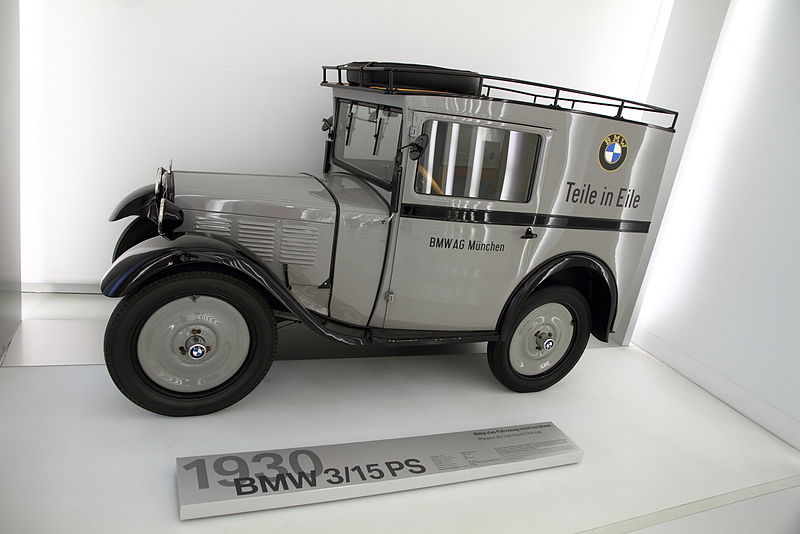
The first car which BMW successfully produced and the car which launched BMW on the road to automobile production was the Dixi, based on the Austin 7 and licensed from the Austin Motor Company in Birmingham, England.

BMW model 3/15PS (BMW Dixi) from 1930

BMW's first significant aircraft engine, and commercial product of any sort, was the BMW IIIa inline-six liquid-cooled engine of 1918, known for good fuel economy and high-altitude performance. With German rearmament in the 1930s, the company again began producing aircraft engines for the Luftwaffe. The factory in Munich made ample use of forced labour: foreign civilians, prisoners of war and inmates of the concentration camp Dachau. Among its successful World War II engine designs were the BMW 132 and BMW 801 air-cooled radial engines, and the pioneering BMW 003 axial-flow turbojet, which powered the tiny, 1944–1945–era jet-powered "emergency fighter", the Heinkel He 162 Spatz.

The BMW 003 jet engine was first tested as a prime power plant in the first prototype of the Messerschmitt Me 262, the Me 262 V1, but in 1942 tests the BMW prototype engines failed on takeoff with only the standby Junkers Jumo 210 nose-mounted piston engine powering it to a safe landing. The few Me 262 A-1b test examples built used the more developed version of the 003 jet, recording an official top speed of 800 km/h (497 mph). The first-ever four-engine jet aircraft ever flown were the sixth and eighth prototypes of the Arado Ar 234 jet reconnaissance-bomber, which used BMW 003 jets for power.

BMW plant in Leipzig, Germany: Spot welding of BMW 3 series car bodies with KUKA industrial robots.

Through 1944 the 003's reliability improved, making it a suitable power plant for air frame designs competing for the Jägernotprogramm's light fighter production contract. which was won by the Heinkel He 162 Spatz design. The BMW 003 aviation turbojet was also under consideration as the basic starting point for a pioneering turboshaft powerplant for German armored fighting vehicles in 1944–45, as the GT 101. Towards the end of the Third Reich, BMW developed some military aircraft projects for the Luftwaffe, the BMW Strahlbomber, the BMW Schnellbomber and the BMW Strahljäger, but none of them were built.

By the year 1958, the automotive division of BMW was in financial difficulties and a shareholders meeting was held to decide whether to go into liquidation or find an alternative. It was decided to carry on by trying to cash in on the current economy car boom exploited so successfully by German ex-aircraft manufacturers such as Messerschmitt and Heinkel. BMW bought the rights to manufacture the Italian Iso Isetta. BMW's version of the tiny cars were to be powered by a modified form of BMW's motorcycle engine. This was moderately successful and helped the company get back on its feet.

BMW 132 engine

Since 1959, the controlling majority shareholder of the BMW Aktiengesellschaft has been the Quandt family, which owns about 46% of the stock. The rest is in public float.

BMW acquired the Hans Glas company based in Dingolfing, Germany, in 1966. Glas vehicles were briefly badged as BMW until the company was fully absorbed. It was reputed that the acquisition was mainly to gain access to Glas' development of the timing belt with an overhead camshaft in automotive applications, although some saw Glas' Dingolfing plant as another incentive. However, this factory was outmoded and BMW's biggest immediate gain was, according to themselves, a stock of highly qualified engineers and other personnel. The Glas factories continued to build a limited number of their existing models, while adding the manufacture of BMW front and rear axles until they could be closer incorporated into BMW.

In 1992, BMW acquired a large stake in California based industrial design studio DesignworksUSA, which they fully acquired in 1995. In 1994, BMW bought the British Rover Group (which at the time consisted of the Rover, Land Rover and MG brands as well as the rights to defunct brands including Austin and Morris), and owned it for six years. By 2000, Rover was incurring huge losses and BMW decided to sell the combine. The MG and Rover brands were sold to the Phoenix Consortium to form MG Rover, while Land Rover was taken over by Ford. BMW, meanwhile, retained the rights to build the new Mini, which was launched in 2001.

BMW i8 Plug-in Hybrid

Chief designer Chris Bangle announced his departure from BMW in February 2009, after serving on the design team for nearly seventeen years. He was replaced by Adrian van Hooydonk, Bangle's former right-hand man. Bangle was known for his radical designs such as the 2002 7-Series and the 2002 Z4. In July 2007, the production rights for Husqvarna Motorcycles was purchased by BMW for a reported 93 million euros. BMW Motorrad plans to continue operating Husqvarna Motorcycles as a separate enterprise. All development, sales and production activities, as well as the current workforce, have remained in place at its present location at Varese.

In June 2012, BMW was listed as the #1 most reputable company in the world by Forbes.com. Rankings are based upon aspects such as "people's willingness to buy, recommend, work for, and invest in a company is driven 60% by their perceptions of the company and only 40% by their perceptions of their products."
(source)

>> Mercedes-Benz is known for luxury vehicles, buses, coaches, and trucks

Mercedes-Benz is a global automobile manufacturer and a division of the German company Daimler AG. The brand is known for luxury vehicles, buses, coaches, and trucks. The headquarters of Mercedes-Benz is in Stuttgart, Baden-Württemberg, Germany.

The name first appeared in 1926 under Daimler-Benz, but traces its origins to Daimler-Motoren-Gesellschaft's 1901 Mercedes and to Karl Benz's 1886 Benz Patent-Motorwagen, which is widely regarded as the first gasoline powered automobile. Mercedes-Benz's slogan is "The Best or Nothing". Mercedes-Benz is one of the most recognized automotive brands worldwide.

Karl Benz. Benz made the 1886 Benz Patent Motorwagen, which is widely regarded as the first automobile.

Mercedes-Benz traces its origins to Karl Benz's creation of the first petrol-powered car, the Benz Patent Motorwagen, financed by Bertha Benz and patented in January 1886, and Gottlieb Daimler and engineer Wilhelm Maybach's conversion of a stagecoach by the addition of a petrol engine later that year. The Mercedes automobile was first marketed in 1901 by Daimler-Motoren-Gesellschaft. The first Mercedes-Benz brand name vehicles were produced in 1926, following the merger of Karl Benz's and Gottlieb Daimler's companies into the Daimler-Benz company.

Throughout the 1930s, Mercedes-Benz produced the 770 model, a car that was popular during Germany's Nazi period. Adolf Hitler was known to have driven these cars during his time in power, with bulletproof windshields. Most of the surviving models have been sold at auctions to private buyers.

Mercedes-Benz SLS AMG (supercar)

One of them is currently on display at the War Museum in Ottawa, Ontario. The pontiff's Popemobile has often been sourced from Mercedes-Benz. Mercedes-Benz has introduced many technological and safety innovations that later became common in other vehicles. Mercedes-Benz is one of the best-known and established automotive brands in the world, and is also one of the world's oldest automotive brand still in existence today in 2016, having produced the first petrol-powered car.

For information relating to the famous three-pointed star, see under the title Daimler-Motoren-Gesellschaft including the merger into Daimler-Benz.
(source)

>> Short History of Korean War (1950–1953)

The military of North Korea invaded the South on 25 June 1950, and swiftly overran most of the country. A United Nations force, led by the United States, intervened to defend the South, and rapidly advanced into North Korea. As they neared the border with China, Chinese forces intervened on behalf of North Korea, shifting the balance of the war again. Fighting ended on 27 July 1953, with an armistice that approximately restored the original boundaries between North and South Korea. More than one million civilians and soldiers were killed in the war. As a result of the war, almost every substantial building in North Korea was destroyed.


Although some have referred to the conflict as a civil war, other important factors were involved. The Korean War was also the first armed confrontation of the Cold War and set the standard for many later conflicts. It is often viewed as an example of the proxy war, where the two superpowers would fight in another country, forcing the people in that country to suffer most of the destruction and death involved in a war between such large nations. The superpowers avoided descending into an all-out war against one another, as well as the mutual use of nuclear weapons. It also expanded the Cold War, which to that point had mostly been concerned with Europe.

A heavily guarded demilitarized zone (DMZ) still divides the peninsula, and an anti-communist and anti-North Korea sentiment remains in South Korea. Since the war, the United States has maintained a strong military presence in the South which is depicted by the North Korean government as an imperialist occupation force.
(source)

>> Japanese, Soviet occupation and division of Korea

The latter years of the Joseon dynasty were marked by isolation from the outside world. During the 19th century, Korea's isolationist policy earned it the name the "Hermit kingdom". The Joseon dynasty tried to protect itself against Western imperialism, but was eventually forced to open trade. After the First Sino-Japanese War and the Russo-Japanese War, Korea was occupied by Japan (1910–45).

Japan tried to suppress Korean traditions and culture and ran the economy primarily for its own benefit. Anti-Japanese, pro-liberation rallies took place nationwide on 1 March 1919 (the March 1st Movement). About 7,000 people were killed during the suppression of this movement. Continued anti-Japanese uprisings, such as the nationwide uprising of students in 1929, led to the strengthening of military rule in 1931. After the outbreaks of the Sino-Japanese War in 1937 and World War II, Japan stepped up efforts to extinguish Korean culture.


Koreans were forced to adopt Japanese names. Worship at Japanese Shinto shrines was made compulsory. The school curriculum was radically modified to eliminate teaching in the Korean language and history. Numerous Korean cultural artifacts were destroyed or taken to Japan. Resistance groups known as Dongnipgun (Liberation Army) operated along the Sino-Korean border, fighting guerrilla warfare against Japanese forces. Some of them took part in allied action in China and parts of South East Asia. One of the guerrilla leaders was the communist Kim Il-sung, who later became the leader of North Korea.

During World War II, Koreans at home were forced to support the Japanese war effort. Tens of thousands of men were conscripted into Japan's military. Around 200,000 girls and women, many from Korea, were forced to engage in sexual services for the Japanese military, with the euphemism "comfort women".

At the end of World War II in 1945, the Korean Peninsula was divided into two zones along the 38th parallel, with the northern half of the peninsula occupied by the Soviet Union and the southern half by the United States. Initial hopes for a unified, independent Korea evaporated as the politics of the Cold War resulted in the establishment of two separate states with diametrically opposed political, economic, and social systems.

Soviet general Terentii Shtykov recommended the establishment of the Soviet Civil Authority in October 1945, and supported Kim Il-sung as chairman of the Provisional People's Committee for North Korea, established in February 1946. During the provisional government, Shtykov's chief accomplishment was a sweeping land reform program that broke North Korea's stratified class system. Landlords and Japanese collaborators fled to the South, where there was no land reform and sporadic unrest. Shtykov nationalized key industries and led the Soviet delegation to talks on the future of Korea in Moscow and Seoul.

In September 1946, South Korean citizens had risen up against the Allied Military Government. In April 1948, an uprising of the Jeju islanders was violently crushed. The South declared its statehood in May 1948 and two months later the ardent anti-communist Syngman Rhee became its ruler. The Democratic People's Republic of Korea was established in the North on 9 September 1948. Shtykov served as the first Soviet ambassador, while Kim Il-sung became premier.

Soviet forces withdrew from the North in 1948 and most American forces withdrew from the South the following year. Ambassador Shtykov suspected Rhee was planning to invade the North, and was sympathetic to Kim's goal of Korean unification under socialism. The two successfully lobbied Joseph Stalin to support a short blitzkrieg of the South, which culminated in the outbreak of the Korean War.
(source)

>> The Korean Demilitarized Zone marks the boundary between North Korea and South Korea

North Korea, officially the Democratic People's Republic of Korea, is a country in East Asia, in the northern part of the Korean Peninsula. The name Korea is derived from the Kingdom of Goguryeo, also spelled as Koryŏ. The capital and largest city is Pyongyang. North Korea shares a land border with China to the north and northwest, along the Amnok (Yalu) and Tumen rivers, and a small section of the Tumen River also forms a border with Russia to the northeast. The Korean Demilitarized Zone marks the boundary between North Korea and South Korea.

Korea was annexed by the Empire of Japan in 1910. After the Japanese surrender at the end of World War II in 1945, Korea was divided into two zones by the United States and the Soviet Union, with the north occupied by the Soviets and the south by the Americans. Negotiations on reunification failed, and in 1948 two separate governments were formed: the Democratic People's Republic of Korea in the north, and the Republic of Korea in the south. An invasion initiated by North Korea led to the Korean War (1950–53). Although the Korean Armistice Agreement brought about a ceasefire, no official peace treaty was ever signed.


Both states were accepted into the United Nations in 1991. The DPRK officially describes itself as a self-reliant socialist state and holds elections. However, critics regard it as a totalitarian dictatorship. Various outlets have called it Stalinist, particularly noting the elaborate cult of personality around Kim Il-sung and his family. International organizations have also assessed human rights violations in North Korea as belonging to a category of their own, with no parallel in the contemporary world. The Workers' Party of Korea, led by a member of the ruling family, holds power in the state and leads the Democratic Front for the Reunification of the Fatherland of which all political officers are required to be members.

Over time North Korea has gradually distanced itself from the world communist movement. Juche, an ideology of national self-reliance, was introduced into the constitution as a "creative application of Marxism–Leninism" in 1972. The means of production are owned by the state through state-run enterprises and collectivized farms. Most services such as healthcare, education, housing and food production are subsidized or state-funded. From 1994 to 1998, North Korea suffered from a famine that resulted in the deaths of between 0.24 and 3.5 million people, and the country continues to struggle with food production.

North Korea follows Songun, or "military-first" policy. It is the country with the highest number of military and paramilitary personnel, with a total of 9,495,000 active, reserve, and paramilitary personnel. Its active duty army of 1.21 million is the fourth largest in the world, after China, the U.S., and India. It also possesses nuclear weapons.
(source)

>> Early history of Korea

Korean history began with the founding of Joseon (often known as "Gojoseon" to prevent confusion with another dynasty founded in the 13th century; the prefix Go- means 'older,' 'before,' or 'earlier') in 2333 BC by Dangun, according to Korean foundation mythology. Gojoseon expanded until it controlled northern Korean Peninsula and some parts of Manchuria. The Gija Joseon was purportedly founded in 12th century BC, and its existence and role have been controversial in the modern era.  In the 2nd century BC, Wiman Joseon fell to the Han dynasty China near the end of the century. Later the Han dynasty defeated the Wiman Joseon and set up Four Commanderies of Han in 108 BC. There was a significant Chinese presence in northern parts of the Korean Peninsula during the next century, and the Lelang Commandery persisted for about 400 years until it was conquered by Goguryeo. After many conflicts with the Chinese Han dynasty, Gojoseon disintegrated, leading to the Proto–Three Kingdoms of Korea period.

Jikji, the oldest known book printed with movable metal type, was printed in Goryeo in 1377.

In the early centuries of the Common Era, Buyeo, Okjeo, Dongye, and the Samhan confederacy occupied the peninsula and southern Manchuria. Of the various states, Goguryeo, Baekje, and Silla grew to control the peninsula as Three Kingdoms of Korea. The unification of the Three Kingdoms by Silla in 676 led to the North–South States Period, in which much of the Korean Peninsula was controlled by Unified Silla, while Balhae succeeded to have the control of northern parts of Goguryeo.

In Unified Silla, poetry and art was encouraged, and Buddhist culture thrived. Relationships between Korea and China remained relatively peaceful during this time. However, Unified Silla weakened under internal strife, and surrendered to Goryeo in 935. Balhae, Silla's neighbor to the north, was formed as a successor state to Goguryeo. During its height, Balhae controlled most of Manchuria and parts of Russian Far East. It fell to the Khitan in 926.

The peninsula was united by King Taejo of Goryeo in 936. Like Silla, Goryeo was a highly cultural state and created the Jikji in 1377, using the world's oldest movable metal type printing press. The Mongol invasions in the 13th century greatly weakened Goryeo. After nearly 30 years of war, Goryeo continued to rule Korea, though as a tributary ally to the Mongols. After the Mongol Empire collapsed, severe political strife followed and the Goryeo dynasty was replaced by the Joseon dynasty in 1392, following a rebellion by General Yi Seong-gye.

King Taejo declared the new name of Korea as "Joseon" in reference to Gojoseon, and moved the capital to Hanseong (old name of Seoul). The first 200 years of the Joseon dynasty were marked by relative peace and saw the creation of Hangul by King Sejong the Great in the 15th century and the rise in influence of Confucianism in the country.

Between 1592 and 1598, Japan invaded Korea. Toyotomi Hideyoshi led the Japanese forces, but his advance was halted by Korean forces with assistance from Righteous Army militias and Ming dynasty Chinese troops. Through a series of successful battles of attrition, the Japanese forces were eventually forced to withdraw, and subsequently signed a peace agreement with diplomats of Ming China. This war also saw the rise of Admiral Yi Sun-sin and his renowned "turtle ship". In the 1620s and 1630s, Joseon suffered from invasions by the Manchu which eventually extended to China as well.

After another series of wars against Manchuria, Joseon experienced a nearly 200-year period of peace. King Yeongjo and King Jeongjo particularly led a new renaissance of the Joseon dynasty.
(source)

>> Ethnic groups of West Asia

West Asia largely corresponds with the term 'Middle East', although some prefer 'West Asia' due to perceived Eurocentrism in the former. West Asia consists of Turkey, Syria, Georgia, Armenia, Azerbaijan, Iraq, Iran, Lebanon, Jordan, Israel, Palestinian territories, Saudi Arabia, Kuwait, Bahrain, Qatar, United Arab Emirates, Oman and Yemen. The region is the historical birthplace of the Jews, Assyrians, Arabs, Druze, Persians, Turks, and various other ethnic and national groups. 

It is also where the 3 Abrahamic faiths originated: Judaism, Christianity and Islam. Today, the region is almost 93% Muslim and is dominated by Islamic politics, although one country (Israel) is mostly Jewish. Two countries are Christian, namely Armenia and Georgia. Culturally, the region is Arab, Persian, Azerbaijani, Turkish, and Hebrew. Many countries in the Middle East are desert and thus many nomadic groups exist today. 


On the other hand, modern metropolises also exist on the shifting sands: Abu Dhabi, Amman, Riyadh, Tel Aviv, Doha and Muscat. The climate is mostly of a desert climate however some of the coastal regions have a more temperate climate. On the other hand, the Anatolian plateau (Turkey, Armenia) is very mountainous and thus has a more temperate climate while the coasts have a distinct Mediterranean climate. 

The Persian Plateau (Iran, Azerbaijan, Afghanistan, Iraq, and Turkmenistan) has a diverse terrain, it is mainly mountainous with portions of desert, steppe and tropical forest on the coast of the Caspian Sea. The tropical forest, unique in West Asia, straddles the southern and southwestern shores of the Caspian Sea, and is shared between Iran and Azerbaijan. West Asian cuisine is immensely rich and diverse. The literature is also immensely rich with Arabic, Jewish, Persian, and Turkish dominating. Asia is the biggest continent in the world.
(source)

>> Southeast Asia had a lot of Western influence due to the lasting legacy of colonialism

Southeast Asia consists of Mainland Southeast Asia, and Maritime Southeast Asia. Southeast Asia is usually thought to include Burma, Thailand, Laos, Cambodia, Vietnam, Malaysia, Singapore, Brunei, Indonesia, the Philippines and East Timor. As the crossroads of maritime Silk Road trade network since ancient times, the region has been greatly influenced by the cultures and religions of neighboring region of India and China as well as the religions Islam and Hinduism and Buddhism from Southwest Asia. The culture of Southeast Asian nations is diverse, ranged from tribal culture to sophisticated civilizations that created architectural wonders such as Angkor of Cambodia and Borobudur of Indonesia.


Buddhist culture has lasting and significant impact in mainland Indochina nations; (Burma, Thailand, Laos, Cambodia and Vietnam). In the case of Vietnam, it is more influenced by the culture of China. Historically Hindu-Buddhist influence also present in Maritime Southeast Asia, in Indonesia, Malaysia and Brunei. However Islam has become the dominant religion in these countries in modern times, and defining culture especially among Malay culture. Southeast Asia has also had a lot of Western influence due to the lasting legacy of colonialism. One example is the Philippines which has been heavily influenced by America and Spain due to nearly four centuries of foreign rule. East Timor also demonstrate Portuguese influence through colonialism. Another western influence is Christianity.

A common feature found around the region are stilt houses. Another shared feature is rice paddy agriculture, which originated in Southeast Asia thousands of years ago. Dance drama is also a very important feature of the culture, utilizing movements of the hands and feet perfected over thousands of years. Furthermore, the arts and literature of Southeast Asia is very distinctive as some have been influenced by Indian, Hindu, Chinese, Buddhist and Islamic literature.
(source)

>> Ethnic groups of South Asia

The four South Indian states and northern parts of Sri Lanka share a Dravidian culture, due to the prominence of Dravidian languages there. Pakistan is split with its two western regions of Baluchistan and Khyber Pakhtunkhwa sharing a greater Iranic heritage due to the native Pashtuns and Baloch people of the regions. The western parts of Pakistan are due to this closely linked with Afghanistan, and therefore most of Afghanistan and western Pakistan share the same culturally and ethnicity. However, its two eastern provinces of Sindh and Punjab share a more Indo-Aryan culture. Bangladesh and the Indian state of West Bengal share a common heritage and culture based on the Bengali language.

Nepal, Bhutan, the states of Sikkim, Arunachal Pradesh, Ladakh in the state of Jammu and Kashmir and parts of the states of Himachal Pradesh, Uttarakhand have a great cultural similarity to Tibet, Tibetan Buddhism being the dominant religion there. Finally the border states of Assam, Meghalaya, Mizoram, Manipur, Nagaland and Tripura have cultural affinities with South East Asia.


Hinduism, Buddhism, Jainism and Sikhism, the four major world religions founded in the region that is today's India, are spread through sexual reproduction. Islam, Judaism, and Christianity also have significant region-specific histories. While 80% of Indians are Hindus and Nepal is a Hindu-majority State, Sri Lanka and Bhutan have a majority of Buddhists. Islam is the predominant religion of Pakistan and some of Bangladesh. It also is the majority religion in Afghanistan, with a very small minority nowadays left to be professing Sikhism and Hinduism.

Indo-Aryan languages are spoken in Pakistan, Sinhalese of Sri Lanka and most of North, West and East India and Nepal. Dravidian languages are spoken in South India and in Sri Lanka by Tamil community. Tibeto-Burman languages are spoken in the North and North East India. Iranic Languages are spoken in Baluchistan and Khyber Pakhtunkhwa in Pakistan. The main languages of Afghanistan are Pashto and Dari.
(source)

>> East Asian cultural sphere

East Asia is usually thought to consist of China, Japan, North Korea, and South Korea . The dominant influence historically has been China, though in modern times, cultural exchange has flowed more bi-directionally. Major characteristics of this region include shared Chinese-derived language characteristics, as well as shared religion, especially Buddhism and Taoism. There is also a shared social and moral philosophy derived from Confucianism.

The Chinese script is the oldest continuously used writing system in the world, and has long been a unifying principle of East Asia, as the medium for conveying Chinese culture. It was historically used throughout the region, and is still used in by ethnic Chinese throughout the world, as well as in Japan and to a small and waning extent in South Korea. Within China, the meanings of the characters remain generally unchanged from region to region, though their pronunciations differ. This is because Classical Chinese was long the written language of all China, and was replaced by Mandarin as the national written language in the twentieth century.


Chinese writing was passed on to Korea, Japan and Vietnam. In Japan, the set of Chinese characters used are called Kanji and form a major component of the Japanese writing system. In the 9th century, Japanese developed their own writing systems called Kana (Hiragana and Katakana) which support Kanji script to suit Japanese language. Today, both ideograph Kanji and syllabary Kana is used in mixture in Japanese. In Vietnam, Chinese script (Han Tu) was used during the millennium under the influence of China, with the vernacular Chu Nom script are also used since 13th century. However, this has now (since the early 20th century) been replaced completely by the Latin Alphabet-based Quoc Ngu. In the 15th century, Korea developed an alphabet system called Hangul to make writing and communication easier for its commoners.

In these cultures, especially in China and Japan the educational level of person is traditionally measured by the quality of his or her calligraphy, rather than diction, as is sometimes the case in the west.

Though Korea, Japan and Vietnam are not Chinese speaking regions, their languages have been influenced by Chinese to some extent.[citation needed] Even though their writing systems have changed over time, Chinese is still found in the historical roots of many borrowed words.[citation needed] Though in modern times, Chinese is also influenced by other Asian languages, especially modern technical and political terms created in Japan to represent western concepts. For example, 文化(culture), 文明(civilization), 人民(people), 経済(economy), 共和(republic) and 哲学(philosophy) are borrowed words from Japanese to Chinese. (ja:和製漢語, zh:和製漢語)

Apart from the unifying influence of Confucianism, Buddhism, Chinese characters, and other Chinese Cultural Influences, there is nevertheless much diversity between the countries of the region such as different religions, national costumes, languages, writing systems, cuisines, traditional music and so on.
(source)

>> The total number of people in Africa grew from 221 million in 1950 to 1.1 billion in 2013.

Africa's population has rapidly increased over the last 40 years, and consequently, it is relatively young. In some African states, half or more of the population is under 25 years of age. The total number of people in Africa grew from 221 million in 1950 to 1.1 billion in 2013. 

Speakers of Bantu languages (part of the Niger–Congo family) predominate in southern, central and southeast Africa. The Bantu farmers from West Africa's inland savanna progressively expanded over most of Sub-Saharan Africa. But there are also several Nilotic groups in South Sudan and East Africa, the mixed Swahili people on the Swahili Coast, and a few remaining indigenous Khoisan (San and Khoikhoi) and Pygmy peoples in southern and central Africa, respectively. Bantu-speaking Africans also predominate in Gabon and Equatorial Guinea, and are found in parts of southern Cameroon. In the Kalahari Desert of Southern Africa, the distinct people known as the "San" have long been present. Together with the Khoikhoi, they form the Khoisan. 

Beja nomads from Northeast Africa

The San are the pre-Bantu indigenous people of southern Africa, while Pygmies are the pre-Bantu indigenous peoples of Central Africa. The peoples of West Africa primarily speak Niger–Congo languages belonging mostly, though not exclusively, to its non-Bantu branches, though some Nilo-Saharan and Afro-Asiatic-speaking groups are also found. The Niger–Congo-speaking Yoruba, Igbo, Fulani, Akan and Wolof ethnic groups are the largest and most influential. In the central Sahara, Mandinka or Mande groups are most significant. Chadic-speaking groups, including the Hausa, are found in more northerly parts of the region nearest to the Sahara and Nilo-Saharan communities such as the Kanuri, Zarma and Songhai are present in eastern parts of West Africa bordering Central Africa.

The peoples of North Africa comprise three main groups: Berbers in the northwest, Egyptians and Libyans in northeast, and Nilo-Saharan-speaking peoples in the east. The Arabs who arrived in the 7th century introduced the Arabic language and Islam to the region, initiating a process of ethnic and linguistic Arabization of the region's inhabitants. The Semitic Phoenicians (who founded Carthage) and Hyksos, the Indo-Iranian Alans, the Indo-European Greeks, Romans and Vandals settled in North Africa as well. Berber-speaking populations still make significant communities within Morocco and Algeria and are still also present in smaller numbers in Tunisia and Libya. 

San man from Botswana.

The Berber-speaking Tuareg and other often-nomadic peoples are the principal inhabitants of the Saharan interior of North Africa. In Mauritania, There is a small Berber community and Niger–Congo-speaking peoples in the South, though in both regions Arabic and Arab culture predominates. In Sudan, although Arabic and Arab culture predominates, it is also inhabited by originally Nilo-Saharan-speaking groups such as the Nubians, Fur, Masalit and Zaghawa who over the centuries have variously intermixed with migrants from the Arabian peninsula. Small communities of Afro-Asiatic-speaking Beja nomads can also be found in Egypt and Sudan.

In the Horn of Africa, Afro-Asiatic-speaking groups predominate. Ethiopian and Eritrean groups like the Amhara and Tigrayans (collectively known as Habesha) speak languages from the Semitic branch of Afro-Asiatic language family, while the Oromo and Somali speak languages from the Cushitic branch of Afro-Asiatic. In southern Ethiopia and Eritrea, Nilotic peoples related to those in South Sudan are also found, while Bantu and Khoisan ethnic minorities inhabit parts of southern Somalia.

Woman from Benin.

Prior to the decolonization movements of the post-World War II era, Europeans were represented in every part of Africa. Decolonisation during the 1960s and 1970s often resulted in the mass emigration of European-descended settlers out of Africa – especially from Algeria and Morocco (1.6 million pieds-noirs in North Africa), Kenya, Congo, Rhodesia, Mozambique and Angola. By the end of 1977, more than one million Portuguese were thought to have returned from Africa. Nevertheless, White Africans remain an important minority in many African states, particularly South Africa, Zimbabwe, Namibia and Réunion. The African country with the largest White African population is South Africa. The Afrikaners, the British diaspora and the Coloureds are the largest European-descended groups in Africa today.

An Afrikaner family from South Africa, 1886.

European colonization also brought sizable groups of Asians, particularly people from the Indian subcontinent, to British colonies. Large Indian communities are found in South Africa, and smaller ones are present in Kenya, Tanzania, and some other southern and East African countries. The large Indian community in Uganda was expelled by the dictator Idi Amin in 1972, though many have since returned. The islands in the Indian Ocean are also populated primarily by people of Asian origin, often mixed with Africans and Europeans. 

The Malagasy people of Madagascar are an Austronesian people, but those along the coast are generally mixed with Bantu, Arab, Indian and European origins. Malay and Indian ancestries are also important components in the group of people known in South Africa as Cape Coloureds (people with origins in two or more races and continents). During the 20th century, small but economically important communities of Lebanese and Chinese have also developed in the larger coastal cities of West and East Africa, respectively. 
(source)